Mrs. McDonald
You have reached the web page for Megan McDonald.
Edgartown School Physical Education Department

Welcome to The Edgartown School’s Physical Education Department
Any questions please contact me at:
mmcdonald@mvyps.org
Dear Students and Family Members,
This will be my third year in my role as physical education teacher and I am so excited to keep the momentum going! My biggest requirement in my class is to get your body moving. During the school year, students will learn many different games, activities, and sports to bring movement into their lives. Please feel free to reach out to me with any questions or concerns you may have.
Best,
Megan McDonald
mmcdonald@mvyps.org (email me with any questions)
Supplies for Physical Education: sneakers, hair ties, clothing they can move in.
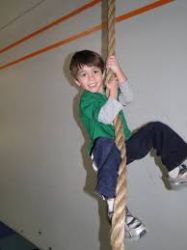
Please dress for success. Children should wear sneakers (Crocs, Hey Dudes, and Uggs are not the best support) and clothing they can move in. Girls should tie their hair back and out of the way. We run, jump, dance, and climb – to name just a few but the kids are really disappointed if they cannot participate due to lack of preparation! Junior high students are given time to change if they need to. Being prepared is key to success, leave a pair of sneakers in your locker! Alternative assignments are used when needed.
Guidelines for Success in Physical Education:
My fifth and sixth grade classes meet twice a week for 50 minutes and seventh and eighth grade meets once for 55 minutes. Our department dedicates itself to offering appropriate educational experiences and activities. The experiences are designed to enhance moral, intellectual, emotional, social and physical growth in the students. Activities utilized in class are created to help students acquire self-esteem & self-discipline, encourage honesty & differences, and develop skills for personal fitness, recreational games and physical/health and well-being.
Why Children need Physical Education
Physical education is an integral part of the total education of every child in kindergarten through Grade 12. Quality physical education programs are needed to increase the physical competence, health-related fitness, self-responsibility and enjoyment of physical activity for all students so that they can be physically active for a lifetime. Physical education programs can only provide these benefits if they are well-planned and well implemented.
Improved Physical Fitness
Improves children’s muscular strength, flexibility, muscular endurance, body composition and cardiovascular endurance.
Skill Development
Develops motor skills which allow for safe, successful and satisfying participation in physical
activities.
Regular, Healthful Physical Activity
Provides a wide-range of developmentally appropriate activities for all children.
Support of other Subject Areas
Reinforces knowledge learned across the curriculum. Serves as a lab for application of
content in science, math and social studies.
Self Discipline
Facilitates development of student responsibility for health and fitness.
Improved Judgment
Quality physical education can influence moral development. Students have the opportunity
to assume leadership, cooperate with others; question actions and regulations and accept responsibility for their own behavior.
Stress Reduction
Physical activity becomes an outlet for releasing tension and anxiety, and facilitates
emotional stability and resilience.
Strengthened Peer Relationships
Physical education can be a major force in helping children socialize with others successfully
and provides opportunities to learn positive people skills. Especially during late childhood and adolescence, being able to participate in dances, games and sports is an important part of
peer culture.
Improved Self-Confidence and Self-Esteem
Physical education instills a stronger sense of self-worth in children based on their mastery
of skills and concepts in physical activity. They can become more confident, assertive,
dependent and self-controlled.
Experience Setting Goals
Gives children the opportunity to set and strive for personal, achievable goals.
Copyright ©2011

Proper Attire for Class
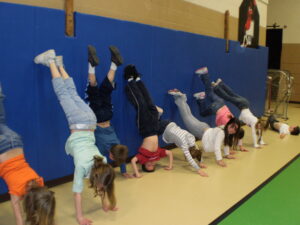
- All students have been reminded that they must wear sneakers and socks during physical education class. This rule is for his/her own safety as well as the safety of other students. No high heels (including wedges), clogs, boots or sandals, will be permitted and the students will be asked to sit out of the fun activities for the day.
If Your Child Cannot Participate…
- All students will participate in activities scheduled unless a written reason is given. If illness or injury persists, please have a doctor write a note explaining restrictions your child has, as well as the duration of the injury or illness. We take our curriculum seriously and will use alternative assignments to help students stay current with the content if needed. Assignments could include reporting on a specific topic or current event that is researched in the library, shared with the class and posted on the information board. This happens specifically when a student is unprepared for a number of times and begins to hinder their progress.
Expectations
Your student’s progress will be monitored on how they perform in these five categories: 1. Demonstrates fundamental skills 2. Demonstrates sportsmanship and respect for others 3. Actively Participates 4. Demonstrates responsible behavior, cooperates, and follows directions 5. Physical Education tests
Early Bird Special
Open Gym will be available everyday from 7:30-8:10. Students should eat breakfast before coming to the gym and also need to meet the eligibility criteria. This is a great way for kids to get their day started with some movement and activity.
Massachusetts State PE Standards and National PE Standards
By the end of grade 5 :Through the study of Motor Skill Development students will: 2.1 Apply movement concept including directionality, balance, level (high, low) pathway (straight, curve zigzag), range (expansive, narrow), and force (rigid,, soft) to extend versatility and improve physical performance. 2.2 Use a variety of manipulative, locomotor skills (walking, running, skipping, hopping etc..) and non locomotor skills (twisting, bending, extending etc.) for individual performance and group performances. 2.3 Perform rhythm routines, including jump roping and dance skills to demonstrate fundamental movement skills. Through the study of Fitness students will: 2.4 Identify physical and psychological changes that result from participation in a variety of physical activities. 2.5 Explain the benefits of physical fitness to good health and an increased active lifestyle. 2.6 Identify the major behaviors that contribute to wellness (exercise, nutrition, hygiene,rest, and recreation, refraining from using tobacco, alcohol and other substances). Through the study of Personal and Social Competency students will: 2.7 Demonstrate responsible personal and social conduct used in physical activity and dynamic environments. By the end of grade 8:Through the study of Motor Skills Development students will: 2.8 Use combinations of manipulative, locomotor and non-locomotor skills to develop movement sequences and patterns, both individually and with others. 2.9 Demonstrate developmentally appropriate basic manipulative and advance specialized physical skills, including throwing and catching different objects with both accuracy and force, hand and foot dribbling, and accurate striking proficiency. 2.10 Perform a rhythm routine that combines traveling, rolling, balancing and weight transfer into smooth flowing sequences with intentional changes in direction, speed and flow. Through the study of Fitness students will: 2.11 Apply basic principles of training and appropriate guidelines of exercise to improve immediate and long-term physical fitness. 2.12 Participate in activities that promote physical fitness, decrease sedentary lifestyle, and relieve mental emotional tension and stress. 2.13 Explain the personal benefits of making positive decisions and monitor progress towards personal wellness. Through the study of Personal and Social Competency students will: 2.14 Apply advanced movement concepts and beginning game strategies to guide and improve individual and team performance. 2.15 Demonstrate strategies for inclusion of all students in physical activity settings. 2.16 Describe the purpose and benefits of sports, games and dance in modern society.
National Standards for K-12 Physical Education
The goal of physical education is to develop physically literate individuals who have the knowledge, skills and confidence to enjoy a lifetime of healthfulphysicalactivity.
To pursue a lifetime of healthful physical activity, a physically literate individual*:
- Has learned the skills necessary to participate in a variety of physical activities.
- Knows the implications and the benefits of involvement in various types of physical activities.
- Participates regularly in physical activity.
- Is physically fit.
- Values physical activity and its contributions to a healthful lifestyle.
Standard 1. The physically literate individual demonstrates competency in a variety of motor skills and movement patterns.
Standard 2. The physically literate individual applies knowledge of concepts, principles, strategies and tactics related to movementand performance.
Standard 3. The physically literate individual demonstrates the knowledge and skills to achieve and maintain a health-enhancing level of physical activity and fitness.
Standard 4. The physically literate individual exhibits responsible personal and social behavior that respects self and others.
Standard 5. The physically literate individual recognizes the value of physical activity for health, enjoyment, challenge, self-expression and/or social interaction.